di Andrea Romanazzi
Discovering Iolo Morganwg the first Neo-Druid
In the vast and rich panorama of Welsh literature, one figure stands out as both iconic and enigmatic: Iolo Morganwg. He is remembered not only for his remarkable poetic achievements but, above all, for being the key figure responsible for the revival of druidic culture in the 18th and 19th centuries. His contributions extended far beyond literature, as he played a crucial role in shaping the modern perception of Druidism, intertwining historical tradition with creative reconstruction. His work continues to exert a profound influence on contemporary neo-Druidism, offering both inspiration and controversy.
At the heart of his legacy lies Barddass, a collection of writings that purportedly preserve ancient druidic wisdom. This text is often regarded as a cornerstone of neo-Druidic thought, offering a framework of mystical teachings, poetic reflections, and spiritual insights. However, Barddass is not without its critics. The authenticity of its contents has long been the subject of debate, with some scholars arguing that it is less a historical record and more a product of Morganwg’s own imaginative and intellectual efforts.
This article aims to take a closer look at Barddass, examining its distinctive features, its complex origins, and its enduring impact on modern neo-Druidic practice. By delving into the significance of Iolo Morganwg’s work, we can better understand how his vision shaped—and in some cases, redefined—the evolving landscape of neo-Druidism.
Iolo Morganwg: The Man Behind the Myth
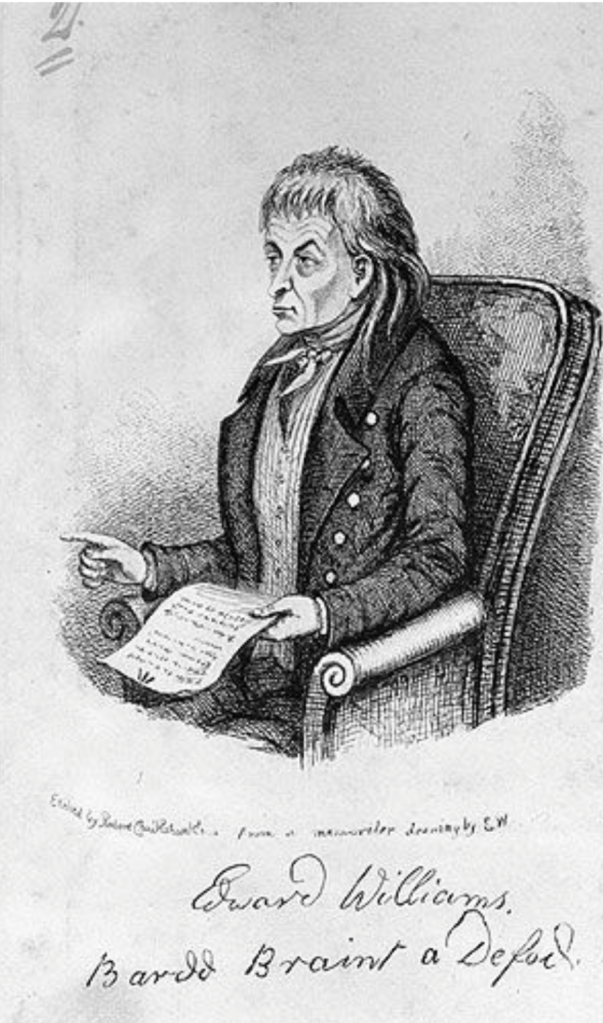
Edward Williams, better known as Iolo Morganwg (1747–1826), was a poet, antiquarian, and self-styled druid whose influence on Welsh cultural identity remains unparalleled. A deeply passionate and highly imaginative individual, he sought to revive what he believed to be the ancient druidic traditions of Wales. However, his approach was not purely historical; rather, it was a fusion of genuine historical fragments, folklore, and his own literary and philosophical creations.
Morganwg’s work was instrumental in establishing the Gorsedd of Bards (Gorsedd Beirdd Ynys Prydain), an institution that continues to play a central role in Welsh cultural and literary life today. He envisioned Druidism as a spiritual and poetic tradition, deeply rooted in nature and the mysteries of the cosmos. His interpretations of druidic philosophy were infused with a romanticized vision of the past, one that sought to elevate Wales as a beacon of ancient wisdom.
Yet, Morganwg was also a complex and contradictory figure. On one hand, he was a scholar dedicated to preserving Welsh traditions; on the other, he was known to have fabricated documents, merging genuine historical material with his own inventions. This duality makes his work both fascinating and problematic for those attempting to separate historical fact from creative embellishment.
Barddass: The Controversial Text
Among Morganwg’s most significant contributions to neo-Druidism is Barddass, a collection of texts that he claimed contained the secret wisdom of the ancient bards and druids. Published in two volumes by the Welsh Manuscripts Society, the first volume of 1862 was based on manuscripts signed under the pseudonym “Plennydd,” originally attributed to Llewellyn Sion of Glamorgan before being passed into Morganwg’s possession.
The text is a synthesis of various elements: philosophical musings, linguistic analyses, and spiritual doctrines. It presents a vision of Druidism that is structured, mystical, and infused with esoteric symbolism. Notably, Barddass introduces a druidic “theology,” positing two opposing cosmic forces—God, representing the energy of life, and Cythrawl, a destructive force emanating from Annwn, the Abyss. This dualistic framework deeply influenced later interpretations of neo-Druidic cosmology.
Other sections of Barddass delve into poetic techniques, Druidic symbols, and rites. It also includes numerous short poems attributed to legendary bards such as Talhaiarn Tadawen, Peredur, Taliesin, and Myrddin, reinforcing the connection between Druidism and the poetic tradition. The extensive use of triads in the text also inspired the triadic structures commonly found in modern neo-Druidic teachings.
Despite its profound impact, Barddass has been met with skepticism. The second volume, published in 1874, was found unfinished in a warehouse and was likely one of Morganwg’s forgeries. While some view Barddass as a historical text, others regard it as a mythopoetic creation—an attempt to fill the gaps in historical knowledge with an idealized vision of the past.
The Awen: Divine Inspiration in Neo-Druidism
According to historian Jan Morris, Iolo Morganwg was responsible for creating the modern symbol of Awen. The term “Awen” originates from Welsh, Cornish, and Breton, meaning “inspiration,” particularly in a poetic or spiritual context. Those who receive this inspiration, known as “awenydd,” are often poets, diviners, or visionaries.
For contemporary neo-Druidism, Awen is perceived as a flow of energy—a vital force that fuels creativity and spiritual enlightenment. The symbol associated with Awen consists of three straight lines widening downward, often encircled or adorned with three dots at the top. The Order of Bards, Ovates, and Druids (OBOD) interprets the three lines as rays of light representing the triple aspects of divinity and the sun’s positions at solstices and equinoxes, known as the Triad of Albe. Other interpretations link them to land, sea, and air; body, mind, and spirit; or love, wisdom, and truth.
Although attributed to Morganwg, the Awen symbol has been embraced by various neo-Druidic traditions, serving as a powerful representation of divine inspiration and the interconnectedness of all things.
The Druid’s Prayer: A Sacred Invocation
One of Iolo Morganwg’s lasting contributions to neo-Druidic ritual is the Druid’s Prayer (Gweddi’r Derwydd), also known as the Gorsedd Prayer (Gweddi’r Orsedd). This invocation remains a fundamental element of both traditional Gorsedd ceremonies and modern neo-Druidic rites. In contemporary adaptations, the word “Duw” (“God”) is sometimes replaced with “y Dduwies” (“the Goddess”), reflecting the fluid nature of spiritual interpretation in modern Druidry.
The prayer reads:
“God, pour out Your strength;
And in strength, the power to suffer;
And to suffer for the truth;
And in truth, all light;
And in the light, gwynvyd (sky);
And in gwynvyd, love;
And in love, God;
And in God, all goodness.”
This prayer encapsulates core Druidic principles, invoking strength, truth, light, heaven, love, and divinity as essential aspects of the spiritual path. Its adaptability in neo-Druidic practice underscores the evolving and inclusive nature of this spiritual tradition.
Iolo Morganwg’s Barddass remains one of the most influential and debated texts in the world of neo-Druidism. Whether viewed as an authentic remnant of ancient Druidic wisdom or as a creative reconstruction, its impact is undeniable. It has provided a framework for modern Druidic spirituality, offering wisdom, structure, and a deep connection to the Welsh literary tradition.
The question of authenticity does not diminish the significance of Morganwg’s contributions. His work continues to inspire countless individuals to explore Druidism, reconnect with nature, and seek wisdom from the past. In this sense, Barddass transcends its historical controversies, emerging as a living tradition that evolves with the needs of contemporary seekers. Morganwg’s vision, for all its complexities, ensures that the call of the bards and druids will echo for generations to come.


 Centro Studio Misteri Italiani
Lascia un commento