di Andrea Romanazzi
It is known that the Celts possessed a complete system of magic, widely respected in the ancient world. Diodorus Siculus and Clement of Alexandria, an influential second-century Christian teacher, claimed that the Celtic priests of Gaul studied mystical philosophy with Pythagoras. In the first century AD, the Greek rhetorician Dio Chrysostom compared the Celtic Druids to the Persian Magi, Indian Brahmins, and Egyptian priests. Our current knowledge of Celtic spirituality and magical practice is based on Greek and Roman descriptions, some works of the Celts themselves (mainly from Wales, Ireland, and Scotland), folk songs and fairy tales, and a considerable number of imaginative inventions. Despite the challenges related to these sources, it is possible to easily identify shamanic elements, such as magical practices of healing, damage and spiritual warfare, as well as extraordinary abilities such as spellcasting, soul flights, distant visions, animal transformation and understanding the language of birds and some animals.
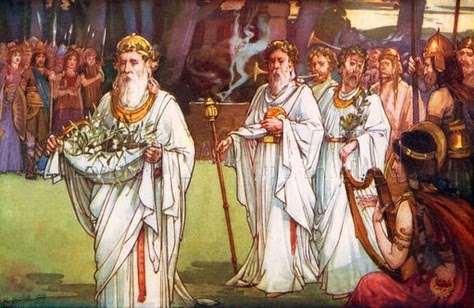
In ages past, a network of formal institutes for the training of druids stretched across the Celtic lands, with the most significant school located on the Isle of Mona (now Anglesey). According to Julius Caesar, Druidic education, which could last up to twenty years, encompassed disciplines such as science, law, practical religion, philosophy and history. Since writing was viewed with distrust for the preservation and transmission of important information, every detail had to be memorized. Unfortunately, details regarding the education have been lost, and it is not known how, or if, the magical initiation was formally conferred. Celtic pagan spirituality understood that the supernatural Other Worlds were so intimately linked to this one that they frequently overlapped and that the magical and numinous element was present in every aspect of life and the surrounding environment. The Celts carefully observed nature to gain an understanding of its deepest secrets, both physically and metaphysically. The earth itself was considered animate and conscious, aware of human activity but intrinsically different in its needs and nature.
Let’s dive into the details of the ancient divinatory arts, where the journey of the soul was not limited to a simple prediction of the future, but encompassed the search into the “other nature” of seemingly ordinary things. The awenyddion, Welsh magical poets of the twelfth century, are among the protagonists of this practice. Giraldo Cambrensis talks about it, describing their entry into a state of profound inspirational ecstasy, with their bodies in frenetic movements, while they sang wild songs. An inspiration so powerful that it forces listeners to extract the useful parts from an incomprehensible stream of words.The journey of the soul, performed through ecstatic poetic trance, careful observation of natural forces, and the flight of the soul into unknown realms, reveals the profound connection between the Celtic druids and the spiritual forces that permeated their world.A significant chapter of this narrative is revealed in the figure of Merlin, protagonist of the Arthurian saga. Merlin, accustomed to soul travel into non-ordinary realms, where space and time took on different forms, is described as one who “lives backwards in time”. For him, prophecy was not a practice of divination, but rather an act of remembering the future. His ability to prophesy with ease was the fruit of an extraordinary connection with the mystical forces that permeated his being.
Celtic prophecy, however, was not just a spiritual exercise, but had a practical intent. In Irish saga tales, Druids were often called upon to make omens on particular days for crucial events, such as births or battles. There are tales of mothers who delayed the birth of their children until a favorable day, according to the prophecy of the Druids. Cathbad, an Irish druid, prophesied that anyone who took up arms on a specific day would have a short life, but with eternal fame. A young warrior named Cuchulainn seized the opportunity and became the hero of a cycle of Irish sagas.
The crystallomancy practiced by Fedelm in the Tain and the use of sheep shoulder blades by the seers of the Scottish Highlands open a window onto a world in which nature is an open book of symbols and omens. Strabo, a historian of the 1st century BC, tells us of ancient practices where a chosen person was hit in the back with a dagger to predict the future through his convulsions. Every element of nature, from the smoke of the fire to the arrangement of the stars, from the clouds in the sky to the desirability of certain days and hours, became a portal through which to peer into the future.
The practice of Celtic divination also extends to the animal kingdom, where animal allies play a key role. Parts of the bull were used as divination tools, and the Iceni warrior queen Boadicea even used a hare to predict the outcome of a battle against the Romans. Careful observation of animals and birds, as evidenced by the rock paintings found in the Camonica Valley in Italy, revealed an ancient dialogue between humanity and nature.
Among animals, ravens emerge as significant figures in Celtic divination. The practice, similar to that still present in contemporary Tibet, involves watching crows for omens of good fortune or impending warnings. The ancient Irish sagas and collections of oral poetry, such as the Carmina Gadelica, tell us how the approach of ravens could be interpreted as an omen of imminent death. In this millenary dialogue between druids and nature, the profound links between humanity and the mystery of life clearly emerge. Divination through nature not only reveals the future, but opens a door to a deeper understanding of the intrinsic connection between humans and the world around them. A connection that, even in the following centuries, continues to resonate with the calls of birds and the whisper of the wind among the leaves of the trees.

 Centro Studio Misteri Italiani
Lascia un commento