

di Andrea Romanazzi
Since the 11th century, numerous folk tales and literary texts have spoken of the appearance of the “furious army,” as it is known in central Europe, a strange procession of mysterious fantastical creatures, later evolving into witches and warlocks ready for their journey to the Sabbath. This band of beings, composed of both men and women, often rode animals somehow connected to the pagan world, such as goats, horses, or strange birds of prey. They were usually led by a mythical being, an ancient indigenous pagan deity like Wotan, Odin, or other beings, often with feminine features, who frequently carried a ritual cart. An interesting area to examine, due to the strong connection between the living and the deceased, is Brittany, where ancient pagan traditions never completely faded, blending seamlessly with the official religion.
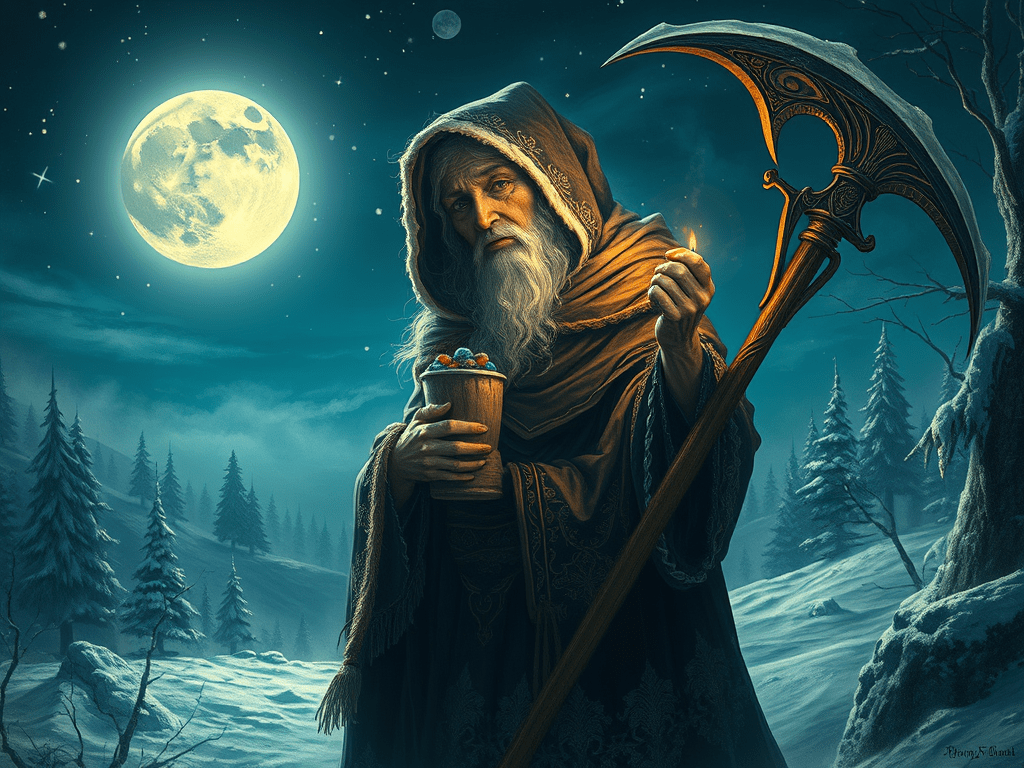
The peculiar relationship with the dead still echoes in legends and folk tales today, such as the one about Ankou. Ankou is portrayed as “death,” appearing as a skeleton with a scythe, but it is not merely death personified; it is, in fact, a messenger, a strange figure that arrives to warn people and often advises them to complete unfinished personal tasks before their passing.
Another intriguing piece of information regarding this relationship with the deceased can be gleaned from Procopius of Caesarea’s account in his Gothic War. Speaking of Brittia, he writes, “…I find it inevitable to tell a fact closely related to superstition…” Historian Procopius narrates the peculiar habits of some inhabitants of fishing villages located across the sea, in the area now known as Brittany. Some of these individuals had a strange task: to ferry the souls of the dead. “Late at night, they hear a knock at the door and hear a muffled voice calling them to work. Without hesitation, they jump out of bed and go to the seashore… on the shore, they find special boats, empty. But when they board these boats, they sink almost to the waterline as if they were loaded… after leaving the passengers, they return with the light ships…”
If this account seems unbelievable, one can visit Brittany today and find old, disused boats stranded in sandbanks due to the tide. However, no one dares to move or take them away; even today, these are the boats that ferry the dead.
This is the expression of the local communication with an afterlife never perceived as a dark place, as demonstrated by the numerous cemeteries never isolated from inhabited places.
Moreover, since the time of Claudian, the 5th century, the Breton region was known as the place of the dead. It was here that the location was identified where Odysseus had encountered the dead, and where “peasants see the pale shadows of the dead,” a notion that we will later find associated with Italian territory. Not only that, but it is now well-established that certain journeys undertaken by knights in Breton sagas, such as Parsifal or Lancelot, into desolate lands or towards mysterious castles are nothing but journeys into the world of the deceased, as evidenced by place names like Limors or Schastel le mort.
The same Arthur, in various depictions, would be nothing but the ferryman of the processions of the dead, as seen in the mosaic floor of Otranto, where the sovereign is depicted with a scepter in hand, riding a goat, followed by a retinue of men.
The tradition of the procession of the dead and the sighting of the deceased by peasant people is not exclusively Breton; although this tradition still strongly persists in those lands, folk tales of people periodically witnessing such apparitions are widespread throughout Europe.
In reality, this “spectacle” was not accessible to everyone but only to people with specific powers or those born on particular days.
Often, these individuals were destined for lycanthropy, in reality, shamans and priests who initially wore animal skins, perhaps the precursors of the masquerade on Halloween night.
For primitive people, according to the principles of sympathetic or imitative magic, dressing in animal skins was equivalent to transforming into the animal itself, acquiring its powers and abilities. This is evidenced by the Pawnee hunters or the Mau-Mau, the leopard men, who were a scourge and terror to English soldiers. Similarly, Norse warriors like Ulfhednar, wolf heads, or their distant cousins Berserkers, bear-shirts, were associated with this tradition.
Moreover, dogs and wolves were not chosen randomly; they had always been messengers of the dead. In Orvieto, for example, Hades is depicted with a wolf’s head as a headdress. Going further back, consider the canine-shaped deities associated with the cult of the dead found in Egyptian cosmology, such as Anubis, the jackal god, or the wolf god Ap-uat, who ferried the dead to the afterlife. The Nordic cosmogony is also relevant, where the wolf is a symbol of life, the faithful companion of Odin, but also of the final apocalypse represented by the wolf Fenrir. In Ireland, some mother goddesses guarding important burials are depicted in the company of small dogs. A similar message is present in Germany, where the animal is still a protagonist and the faithful companion of the Germanic goddess Holle, who guides the dead to the underworld.
Returning to Italy and its folklore, in Friuli, for example, Ginzburg points out that “those who see the dead, that is, go with them, are Benandanti.” These were men with specific “powers,” born with the “shirt,” a part of the placenta. Because of this peculiarity, during certain times of the year, they would engage in a struggle against evil forces to ensure fertility for the fields.
Many stories abound about incredible encounters in the countryside with processions of the dead. An interesting adventure occurred to a poor monk in 1091. As he walked along a country path, he was drawn by strange cries and saw a procession among which he recognized some men he knew who had recently died. While we might think that such visions are relegated to a distant past, numerous accounts still exist of Lucanian women who, during the last century, encountered what is called the “Mass of the Dead.” Along the dark paths that lead southern peasant women to their fields, it is common to see a church open and lit, with damned souls inside who either immediately drive away the passersby or convey a message for the world of the living.
“…once, a farmer from Forenza committed with his master to fetch water from a fountain far from the village… the farmer set off, but when he reached the Tromacchio fountain, he saw four people carrying a coffin on their shoulders… he decided to go to the Spando fountain, but here too, the way was blocked by the four… then a priest who had died some time ago came to him, took him by the hand, and said, ‘You shouldn’t make these bets.’”
The strange procession strongly resembles the Renaissance depictions that followed, called “Danse Macabre,” which began to appear around 1400, later interpreted with the theme of death as the “leveller.” Certainly, these motifs draw from much older memories, as evidenced by the primitive procession’s guiding principle.

 Centro Studio Misteri Italiani
Lascia un commento