
di Andrea Romanazzi
The practice of cartomancy, based on the interpretation of playing cards, represents a fascinating journey between mysticism and psychology. To fully understand this tool that has always characterized the magical world, it is essential to immerse oneself in its history, which is rooted in ancient cultures such as China and has reached us through the centuries.
The origin of cartomancy is shrouded in mystery, with traces of its presence dating back to ancient periods in different parts of the world.
Initially, playing cards were intended for recreational purposes, but over time, they also became vehicles for divination. Their transformation from simple entertainment tools to objects with a mystical aura created a bridge between play and prediction. A first stage in the history of cartomancy can be identified in ancient China, where, according to testimonies, playing cards were linked to the mystical “four warriors” represented by what we now call “suits.” The cards then spread to Europe, where, initially perceived as playful elements, they soon transformed into tools of prediction. The first mention of playing cards is found in the Council of Worcester in 1240, where the presence of cards in England in the 13th century is cited. Subsequently, they are mentioned in Francesco Petrarca’s “De remediis utriusque fortunae,” written in 1355, and are again cited in the chronicle of Giovanni di Iuzzo in 1379. As a divination tool, references can be found in Europe as early as the 15th century. In the 1400s, we find the first Italian tarot cards, also known as Visconti tarots. These decks originated in the northern Italian region, particularly around Milan and Ferrara. Although no complete Italian Visconti tarot decks exist today, some cards survive in museum collections and ancient books.
Here, however, we want to focus on another divinatory card deck, that of the Sibyls.
We speak of Marie Anne Adelaide Lenormand (1772–1843), also known as Marie Anne Le Normand, considered the greatest fortune teller of all time. The witch was born on May 27, 1772, in Alençon, Normandy, to Jean Louis Antoine Lenormand, a cloth merchant, and Marie Anne Lenormand. She was orphaned at the age of five and educated in a convent. In 1786, Lenormand left Alençon for Paris. Here she came into contact with famous fortune tellers and began working in the field, giving cartomancy advice to many famous people, including leaders of the French Revolution, Empress Josephine, and Tsar Alexander I. Her activity lasted for over 40 years. In 1814, Lenormand embarked on a second literary career and published many texts, sparking numerous public controversies. She was imprisoned several times, although never for long. She died in Paris on June 25, 1843, and was buried in Division 3 of Père Lachaise Cemetery. She left no heirs except for a nephew who was in the army at the time of her death. A devout Catholic, the nephew burned all her occult materials, taking only the monetary fortune she had left.
She would go on to invent the famous “Sibyl” cards.
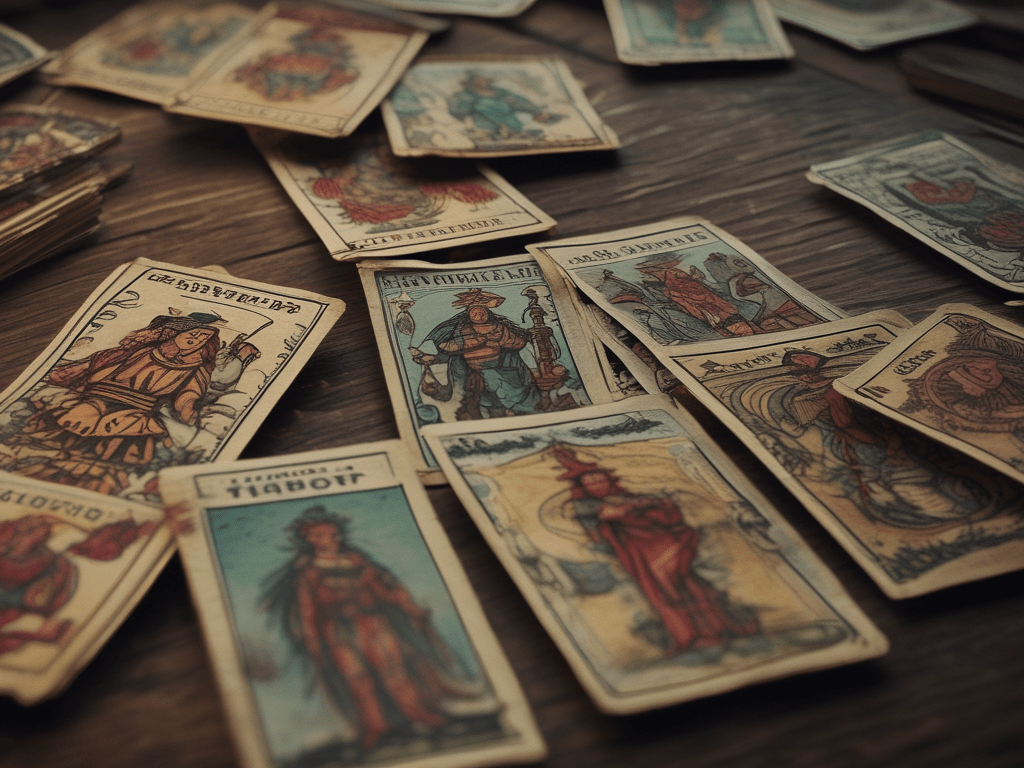
The Sibyls, also known as chattering sibyls or chatterbox cards, are a particular tarot deck consisting of 36 cards. The name originates from the Sibyls, virgins endowed with prophetic virtues, inspired by a god (often Apollo). These priestesses could predict the future and provide answers wrapped in enigmatic mystery. The Sibyl cards were produced and used for divination. The decks incorporated symbols, mythological images, and scenes of everyday life. Each card had a specific meaning, and Sibyl card readers used the arrangement of the cards to interpret the past, present, and future.
These cards are appreciated for their simplicity and intuitiveness. The graphics of the Sibyls are rich in illustrations with immediate meanings, as if instantly suggesting details about the person and the object of the consultation. Hence the name “chattering sibyls.” In addition to the illustrations, there is the suit (corresponding to the deck of Rummy cards) and a number from 1 to 13. Some decks also include numbers associated with the Lotto game. In total, the Sibyl deck consists of 52 cards, each with a general divinatory meaning.
The Sibyls spread in our country mainly through French influence, particularly during the Belle Époque period, between the late 19th and early 20th centuries. Over time, various Sibyl card decks with regional variations and customizations emerged. Each card in the deck has a specific meaning, and Sibyl card readers use the arrangement of the cards to gain insights into personal and future issues.
The popularity of the Sibyl cards has remained strong in Italy, particularly in the context of popular culture and the tradition of divination. The True Italian Sibyl was known in all the popular and aristocratic salons of 19th-century Italy.



 Centro Studio Misteri Italiani
Lascia un commento