di Andrea Romanazzi
Sicilian witchcraft is an ancient tradition rooted in a folk culture rich in myths, legends, and esoteric practices. These beliefs have been passed down from generation to generation, weaving together pagan rituals, Arab influences, and Christian symbolism. In Sicilian tradition, the figure of the witch is a powerful archetype embodying the connection between the natural and supernatural worlds. Witches were seen as holders of occult knowledge who knew how to use herbs, symbols, and words to influence human destiny.
One of the most fascinating and feared practices of witchcraft is the spell (or “fattura”), a magical ritual aimed at influencing or harming someone through physical objects. The spell can be performed using various tools and ingredients, such as dolls, herbs, bones, and nails, each of which holds symbolic meaning and specific power. These practices were often accompanied by invocations and magical formulas that gave the spell greater power.
In a broader context, the spell is a fundamental part of folk magic, present in many cultures with various versions. It represents the human desire to control and manipulate the invisible forces governing fortune, love, health, and life itself. In the practice of spellcasting, the intentions of the magician or witch can vary: they may be malevolent, aiming to cause harm, or benevolent, seeking to protect or heal.
The following text explores a specific form of spellcasting linked to Sicilian tradition, in which heated nails are used as magical tools. This ritual highlights the symbolic and practical use of everyday objects transformed into powerful vehicles of magical intentions, showing how witchcraft practices are deeply rooted in the culture and collective psyche of Sicily.
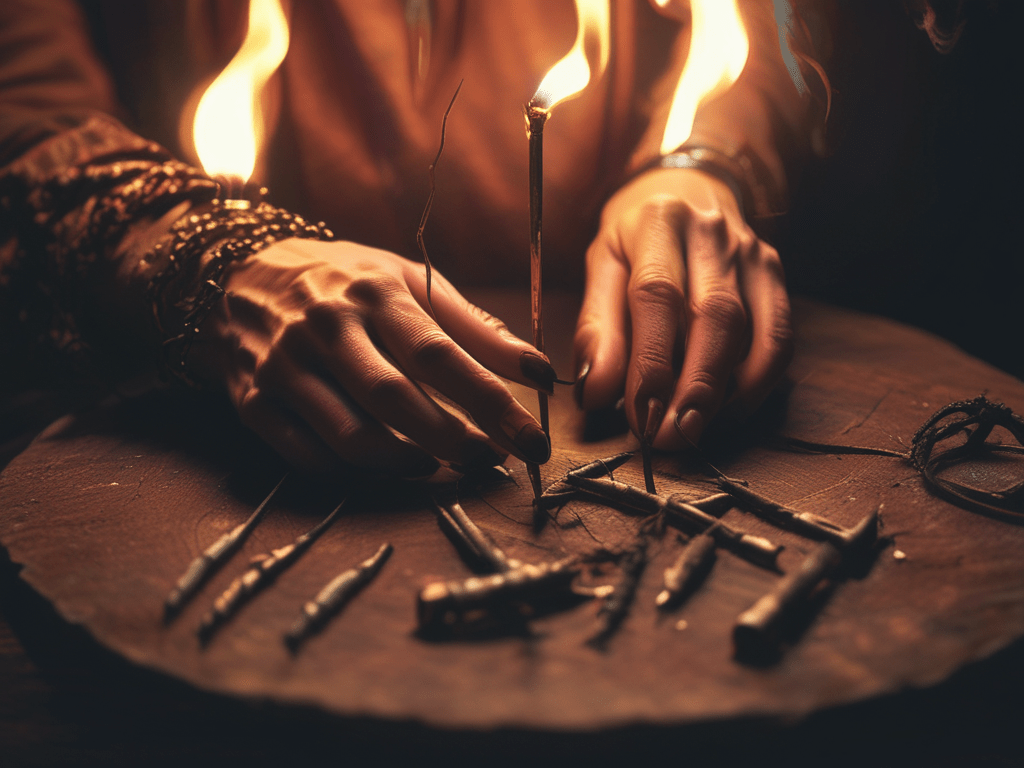
The witch can also perform a spell using ordinary nails, properly heated and then left to cool. They are stuck into an orange, lemon, or boiled egg so that the person on whom the spell is cast feels a burning prick in their head, heart, and feet.
When sticking the first nail, the witch says:
E ti l’appuntu ‘ntesta Pri dariti ‘na pesta.
And I stick it in your head to give you unbearable pain.
When sticking the second nail:
Ti l’appuntu a lu cori Ma nun vogghiu ca mori.
I stick it in your heart, but I don’t want you to die.
When sticking the third nail:
Ti l’appuntu a li peri Pri curriri vulinteri.
I stick it in your feet to make you run willingly.
Now it is time to explain to our readers how and where witches baptize the nails they use for this other system of “spellcasting.” Witches have the skill of placing the nails under the garment of a newborn when it is taken to the baptistery. It is believed that, in this case, the nails receive the baptism, and the child remains pagan.
Such nails can also be used by being planted in a corner of the house, to the left, behind the door, or at noon, one hour into the night, or at midnight. While they remain thus fixed, the person against whom they are planted is believed to writhe in pain as if they were truly driven into their head or chest. When planting them, the witch says:
Sona roggiu, batti a massi, Battu la testa di… ‘Ntesta ti li sentu dari. E tanti ti nn’aju a dari. E a li me pedi t’haju a purtari.
Ring bell, strike the rocks, I strike the head of… On the head, I mean to give them to you, and so many I must give you that to my feet I want to bring you.
Regarding nails: a nail taken from a coffin or a door leading to a tomb is an amulet. Hung above the bed, it wards off bad dreams.

 Centro Studio Misteri Italiani
Lascia un commento