
di Andrea Romanazzi
In Italian folk magic tradition, the use of various types of amulets is very common. This article delves into the topic of coral and its magic and how it is present in many Renaissance paintings.
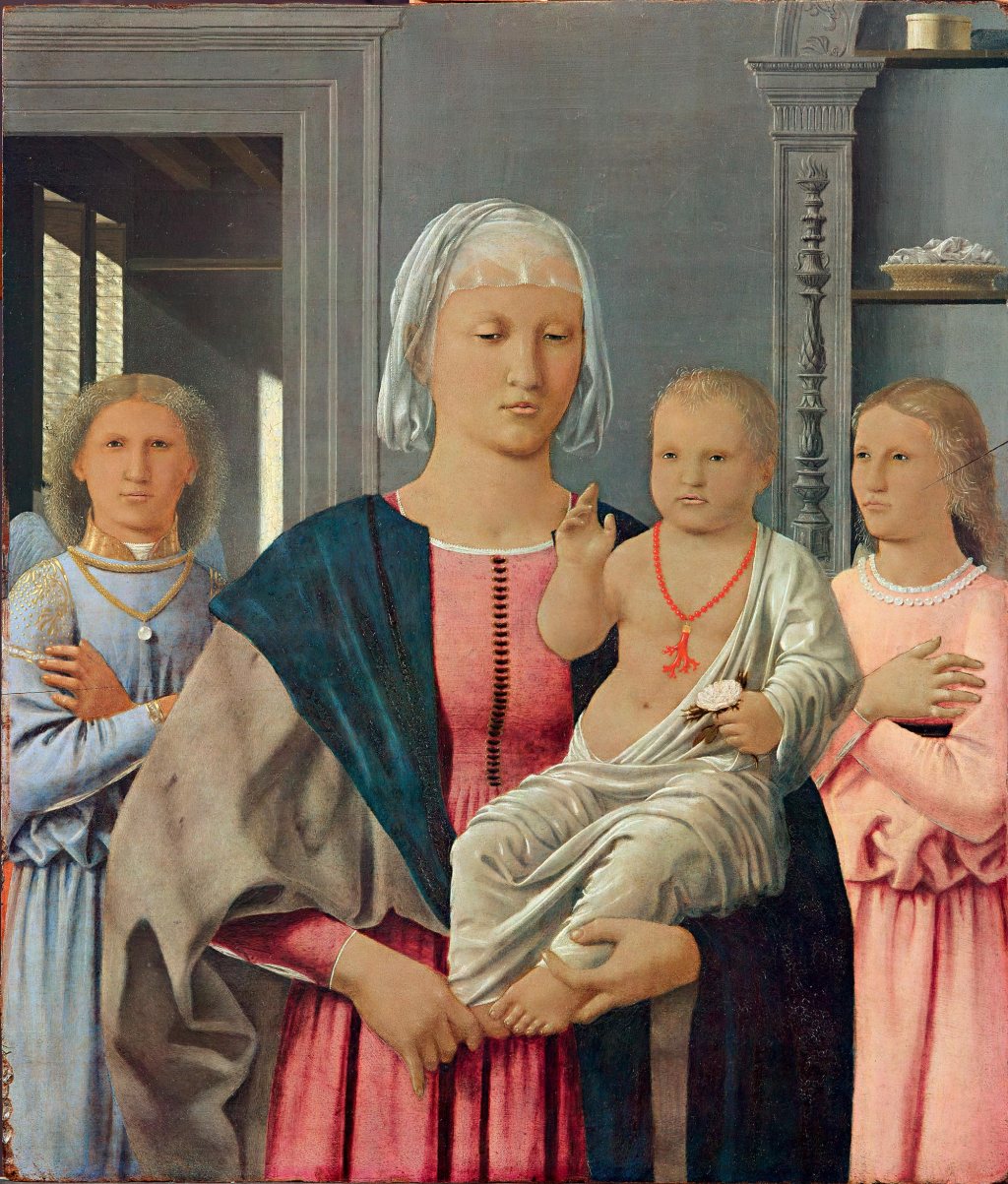
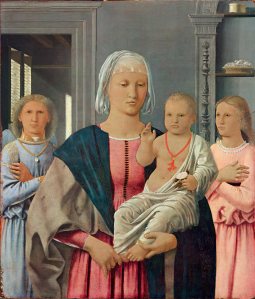
If we take a tour of the castles and museums in the Marche region, we will often come across beautiful Renaissance paintings with sacred themes that are characterized by the presence of an intriguing detail: a coral amulet. The most famous of these paintings, known as the Madonna of Senigallia due to its last known place of origin, is located in the Ducal Palace of Urbino (Fig. 1)
This is an oil painting created by Piero della Francesca between 1470 and 1485. The artist was one of the most emblematic figures of the Italian Renaissance, and there are no shortage of mysteries hidden within his canvases. It is once again Piero della Francesca who paints the coral amulet around the neck of Jesus in the Pala di Brera, or Pala Montefeltro, now housed in the Pinacoteca di Brera (Fig. 2).

Here, the artwork depicts a child Jesus in a very curious position, asleep on His Mother’s lap with the red amulet around His neck. It might seem like an artist’s quirk, a sort of curious ‘signature,’ but it’s not. In fact, if we pay attention, we can find many other canvases with this intriguing detail in the same Ducal Palace of Urbino (Fig. 3).

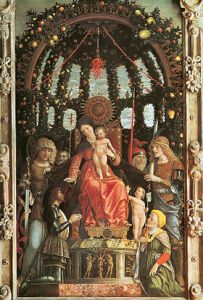
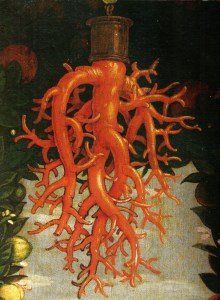
Furthermore, the coral amulet is also present in the altarpiece created by Andrea Mantegna, known as the Madonna della Vittoria, which is now exhibited at the Louvre in Paris. Here, in a kind of ‘triumph of colors’ to celebrate the temporary expulsion of the French from Italy by the Holy League led by Francesco II Gonzaga, we can prominently see a large coral amulet hanging from the head of Christ (Fig. 4-5).
Lesser-known are the Madonna and Child by Jacopo Bellini and the Madonna del Solletico by Masaccio, kept inside the Uffizi Gallery in Florence. In the latter, the coral around the child’s neck is shifted to his shoulder as Christ tries to free himself from the playful fingers of His mother. The list of paintings and panels featuring this curious detail could go on. Numerous are the frescoes from the 15th and 16th centuries, especially in rural churches, where it’s easy to find the child Jesus holding or wearing a sprig of coral in His hands or around His neck. In other cases, necklaces and cords that tie a sprig of coral are prominently displayed on the divine child’s wrist.
Consider the triptych Madonna between Saints Sebastian and Rocco, executed in 1509 for the church of San Silvestro and now visible in the National Museum of Abruzzo, or the Madonna and Child attributed to Silvestro dell’Aquila from the 15th century. Also from Abruzzo is De Litio, who created the fresco of Madonna delle Grazie for the church of Sant’Agostino in Atri, where Jesus is adorned with a beautiful coral necklace.
Of interest and worth mentioning is the Panel, attributed to the school of Fiorenzo di Lorenzo, depicting the Madonna of the Book. Here, the Virgin holds Christ on her lap, and as He looks up at her, He displays the precious amulet around His neck. Many other illustrious names have depicted these superstitious elements in their works. Raphael, in his “Holy Family with a Lamb” (Fig. 7), for instance…

Visible in the Prado Museum in Madrid is a divine child riding a sheep with an apotropaic amulet. Pinturicchio portrays a praying San Bernardino in front of the Child with a necklace and a sprig of coral around His neck, while Cosmè Tura depicts a Circumcision adorned with ‘coral festoons.’ Given the widespread use of this curious symbol, it can be inferred that the coral amulet, rather than being a personal whim of an artist, seems to have a specific meaning. What is it? Well, many descriptions of these works treat the amulet detail quite summarily, suggesting a metaphorical representation of Christ’s blood and His saving function. However, perhaps behind this symbol lies something much simpler but obviously less fitting with the “Christian” image inherent in the work: Renaissance popular magic.
The use of amulets dates back to ancient times, and the term, derived from the Latin “amoliri,” meaning “to ward off,” refers to an object that is sacred in itself because nature imbues it with specific virtues. The amulet is thus a typical expression of animistic religious belief. It is not easy to provide a true classification of amulets. A simple initial division could be related to their effectiveness and the attributed virtues.”
It is precisely among these latter categories that we find coral, whose name is believed to derive from the Greek ‘koraillon,’ meaning ‘hard skeleton,’ or from ‘kura-halos,’ meaning ‘human form.’ For others, it is said to originate from the Hebrew ‘goral,’ which refers to the stones used for oracles in the Middle East and is inherently linked to the magical element. Since prehistoric times, red coral has been considered a powerful apotropaic element against negativity.
For the Greeks, coral was believed to have formed from the blood that flowed from the severed head of Medusa when Perseus beheaded her. This blood, falling into the sea, transformed into the precious underwater branch. It was often used by women to promote milk production, as it was believed to have galactogenic properties. Teenage girls would also wear coral necklaces to regulate their menstrual flow.
However, its most common use was to protect children from negative influences and witches. ‘It is a common belief that certain old women, whom we call witches, suck the blood of children to rejuvenate themselves as much as they can,’ as mentioned by Marsilio Ficino. Acorns, pinecones, pomegranates, roses, and small beads called ‘zingarelli’ were often carved onto coral, all symbols of fertility that enhanced the apotropaic power of the element. In Figures 9 and 10, we can see examples on display at the Museum of Popular Traditions in Rome, demonstrating its widespread use throughout the national territory.
In reality, these necklaces also served a hygienic and health-related purpose, as they protected the baby from skin sores caused by excessive saliva.
The memory of these amulets, far from disappearing with the advent of the New Religion, continues into the Renaissance period in the works of various painters from the Umbrian and Marche schools.
Its presence in sacred paintings, rather than indicating the sacrifice of Christ, serves as a remembrance of a protective use that, evidently, Christ, given His future, would have needed.
In this way, we could divide amulets into four classes or groups:
- **Amulets to prevent or ward off specific natural phenomena and protect people, objects, or animals.
- **Amulets with preventive and curative virtues against certain illnesses.
- **Protective amulets against malevolent spells cast by witches, demons, or other harmful entities.
- **Amulets used to protect newborns and pregnant women
E’ proprio tra quest’ultimi che ritroviamo il corallo, il cui nome deriverebbe dal greco koraillon cioè “scheletro duro“, o da kura-halos cioè “forma umana“. Per altri deriverebbe dall’ebraico goral, ovvero il nome dato alle pietre utilizzate per gli oracoli in Medioriente e dunque già di per sé legato all’elemento magico. Fin dall’epoca preistorica il corallo rosso è stato considerato potente elemento apotropaico contro le negatività. Per i greci il corallo nacque dal sangue sgorgato dalla testa di Medusa recisa da Perseo che, cadendo in mare, si tramutò nel preziosissimo ramoscello acquatico. Era spesso utilizzato dalle donne allo scopo di favorire la produzione di latte, essendo tale materiale anche galattoforo. Collane tramate di corallo erano anche indossate dalle ragazzine in periodo puberale per favorire la regolarità del flusso mestruale. L’utilizzo più comune era però quello di proteggere i bambini dagli influssi negativi e dalle streghe. “E’ comune opinione che certe vecchie, che chiamiamo streghe, sugano il sangue de’ bambini, per ringiovanirsi quanto possono” (M. Ficino). Sul corallo venivano spesso incisi ghiande, pigne, melograni, rose, perline dette “zingarelli”, tutti simboli di fertilità che aumentavano il potere apotropaico dell’elemento. Nelle figure 9 e 10 possiamo vedere degli esempi in mostra al Museo di Tradizioni Popolari di Roma, che dimostra l’enorme diffusione sul territorio nazionale.
In realtà queste collanine avevano anche una funzione igienico-sanitaria, proteggevano infatti il bimbo dalle piaghe cutanee dovute all’eccessiva salivazione.
Il ricordo di questi amuleti, ben lunghi dallo scomparire con l’avvento della Nuova Religione, ricorre così anche in epoca rinascimentale nelle opere di vari pittori di scuole umbre e marchigiane.
La sua presenza nelle tele sacra, più che indicare il sacrificio del Cristo, è la rimembranza di un’utilizzo protettivo di cui, evidentemente, il Cristo, visto il suo futuro, avrebbe avuto bisogno.


 Centro Studio Misteri Italiani
Lascia un commento