
di Andrea Romanazzi
The systematic investigation of Italian magical artifacts requires a rigorous methodological framework that transcends mere descriptive cataloging to embrace a deep hermeneutic understanding. In the complex landscape of Mediterranean folk belief, objects are rarely inert; they are perceived as nodes of power, vessels of intent, and active participants in the negotiation between the human and the supernatural. For the scholar, the museum curator, or the ethnographer, the foundational imperative lies in the precise distinction between the amulet and the talisman.
While these terms are frequently conflated in vernacular discourse, they represent distinct ontological categories with divergent origins and theoretical underpinnings.
The amulet, derived from the Latin amuletum—a term popularized by Pliny the Elder—functions as an apotropaic device. Its purpose is fundamentally defensive, designed to repel malevolent influences, infirmity, or the malocchio (evil eye). The efficacy of the amulet is often considered inherent to its material, its natural form, or a symbol recognized by tradition. Conversely, the talisman—rooted in the Greek télesma (a consecrated rite or object) and transmitted through the Arabic ṭilasm—operates via a magnetic or proactive logic. It is an object created or consecrated according to precise magical, astrological, or cabalistic rules, often at a specific temporal moment. Its purpose is to attract favorable forces, such as prosperity, virility, or divine favor.
The Theoretical Engine: Sympathetic Magic and the Laws of Correspondence
The efficacy of Italian magical artifacts is governed by a coherent system of belief known as sympathetic magic. This theoretical framework posits that objects and actions can influence one another at a distance through invisible connections. To understand the “why” behind the artifact, one must master the two core axioms that provide the engine for their perceived power.
1.1 The Principle of Similarity: The Mimetic Shield
The Principle of Similarity, or the law of “like affects like,” suggests that an object can influence reality by symbolically reproducing either a desired outcome or the threat it intends to neutralize. This homeopathic approach is perhaps most visible in the widespread use of Ocular Amulets. Zoned agates and circular fragments of malachite, colloquially known as “peacock eyes,” are employed to counter the malocchio. The logic is strikingly direct: by presenting a stylized, unblinking eye to the world, the amulet “absorbs” or deflects the first glance of an envious person, neutralizing the malicious gaze before it can strike the wearer.
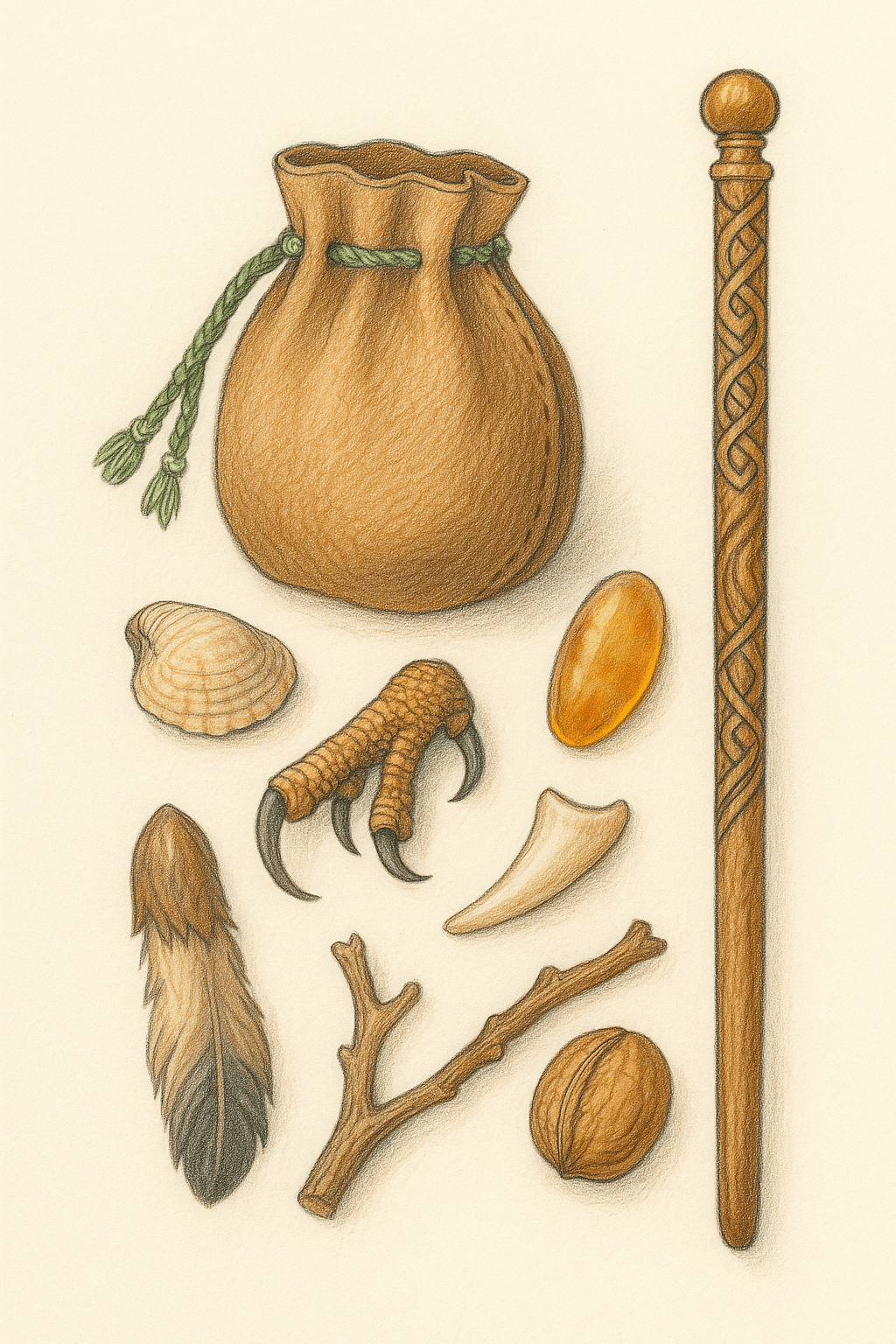
The material composition of an object often dictates its resonance. Rock Crystal (Quarzo Ialino) provides a primary example; its transparency and resemblance to ice or pure water link it to notions of clarity and truth. In the folk traditions of Central Italy, this limpid quality is interpreted as a “screening” mechanism, protecting the soul from deceptive spirits. Similarly, Shells and Marine Husks are frequently utilized as amulets for infants and new mothers. Their morphological resemblance to female genitalia imbues them with a sympathetic link to fertility and the protection of life’s origins.
In a more aggressive application of similarity, we find the Fascinum. This phallic-shaped amulet, rooted in Roman antiquity, represents a potent invocation of generative power. In a worldview where envy was believed to cause a literal “drying up” of resources and health, the fascinum served as a display of overwhelming vitality. Its function was not erotic but defensive; it was a life-force engine meant to shock and repel the “death-force” of the evil eye. This is why the symbol appeared not only as personal jewelry but as architectural protection on doors, milestones, and public walls across the Italian peninsula.
The Frog and Crescent Moon Pendants further exemplify this principle. The frog, an animal that undergoes radical metamorphosis, serves as a cipher for regeneration. When paired with the crescent moon—the ultimate symbol of the cyclical nature of time and cosmic flow—these amulets were used in traditional demoiatria (folk medicine) to ensure healthy growth in children and to ward off mughetto (oral thrush), an ailment seen as a blockage of the natural flow of health.
1.2 The Principle of Contact: The Law of Contagion
The Principle of Contact is founded on the belief that objects which have been in physical proximity to a person or a sacred source retain a permanent, invisible link to that essence. This “contagion” allows the part to represent and influence the whole.
In the realm of Corporeal Contact, we find the most intimate Italian artifacts. The Breve, a small fabric pouch often sewn with red thread, frequently contains locks of hair, fragments of clothing, or even a child’s Milk Tooth. By encasing a piece of the self in a protective silver capsule or a consecrated bag, the wearer ensures that their entire being remains under the protection of the prayers or substances contained within the breve. The Dried Umbilical Cord, preserved in domestic cases, functions similarly as a permanent link to the mother’s protective influence and the child’s vital origins.
Sacred Contact involves the transfer of virtus (divine power) from a holy source to a mundane object. This is the logic behind Relics ex ossibus (of bone) or ex indumentis (of clothing). Furthermore, many Italian folk amulets achieve their power through a process of “infection” at pilgrimage sites. A simple lead medal or a string of beads becomes a potent amulet only after it has been touched to the glass of a saint’s shrine or the wood of a miraculous icon. This physical touch “charges” the object with the saint’s protection, transforming it into a portable extension of the sacred space.
Systematic Typology: A Categorization of Italian Artifacts
A robust cataloging system must categorize artifacts based on their origin and material composition. This allows for cross-regional comparison and the identification of cultural “isoglosses” in magical practice.
2.1 Natural Amulets: The Inherent Power of the Earth
This category includes objects derived directly from the animal, mineral, or vegetable kingdoms, where the power is considered inherent to the substance itself.
- Hag Stones (Pietre Forate): These are stones with natural perforations caused by water erosion. In Italian folk belief, the hole is a “threshold.” These stones were hung in stables to protect livestock or used as “vision stones” to see through the veil of the mundane world.
- Milk Stones (Pietre Galattiti): Smooth, white or light-colored stones that, by similarity, were believed to ensure the flow of breast milk. They were often immersed in water to create a “lithic infusion” for nursing mothers.
- Su Coccu: A quintessential Sardinian amulet consisting of a black sphere (obsidian or onyx) held between two silver caps. Unlike reflective amulets, Su Coccu operates on the principle of absorption. It is believed to “swallow” negative energy; if the stone cracks or falls out, it is said that the amulet has fulfilled its duty by absorbing a particularly lethal dose of envy.
- Porcupine Quills (Aculei di Istrice): Used primarily in Southern Italy, these represent the “magic of points.” Their sharp, defensive nature is believed to puncture the intangible “bubbles” of malice directed at a household.
- Animal Teeth and Claws: The teeth of wolves or badgers were often encased in silver and worn by children. These artifacts function through a dual logic: by contact, they hold the animal’s predatory strength, and by similarity, their sharpness repels the “bite” of misfortune.
2.2 Artificial Amulets: The Power of Human Craft
Artificial amulets derive their efficacy from their culturally significant shape, the metal used (typically silver for its lunar associations), and the ritual intent of the maker.
- The Cimaruta (Sprig of Rue): Perhaps the most complex of all Italian amulets. It is a silver representation of a rue plant, an herb known since antiquity for its medicinal and “sight-clearing” properties. The Cimaruta branches into a variety of symbolic pendants:
- The Key: To open the way to fortune or lock out evil.
- The Crescent Moon: Invoking the protection of Diana or the Virgin Mary (in a syncretic shift).
- The Fish: A symbol of abundance and a veiled reference to the generative power of water.
- The Hand (Mano Fica): A gesture of defiance against the evil eye.
- The Mano Cornuta (Horned Hand): A ubiquitous gesture and amulet representing the horns of a bull or goat. It serves as a defiant, phallic counter-attack against malevolent forces, intended to “gore” the evil eye.
- The Gobbo (Hunchback): The Scartellato or hunchback is a symbol of good luck in Neapolitan tradition. Touching the “hump” is believed to transfer a surplus of vitality and fortune, as the deformity was traditionally seen as a vessel containing extra “soul-stuff” or luck.
2.3 Religious and Syncretic Amulets: The Fusion of Faiths
Italy’s history of religious layering has produced artifacts that exist in the liminal space between official Catholic dogma and ancient folk practice.
- The Hand of Fatima (Hamsa/Khamsa): Found in the coastal regions of Sicily and Southern Italy, this stylized open hand is a trans-cultural Mediterranean symbol. It acts as a universal “stop” sign against evil. In its Italian syncretic form, it may be associated with the “Hand of Mary,” yet it retains its ancient apotropaic function of deflecting envy through its five fingers (representing the five pillars or the five senses).
- Agnus Dei: These were wax disks blessed by the Pope, often encased in elaborate embroidery or silver frames. While officially religious, they were treated by the populace as powerful amulets against lightning, fire, and childbirth complications, functioning through the principle of sacred contact with the Vicar of Christ.
- The Crown of Thorns and Passion Instruments: Small silver charms representing the nails, hammer, and thorns of the Crucifixion were often worn together. These function through a logic of “sympathetic suffering,” where the wearer is protected from harm by carrying the symbols of the ultimate divine sacrifice.
Conclusion: The Artifact as a Cultural Text
The cataloger must recognize that an Italian magical artifact is never “just” a piece of jewelry or a curious stone. It is a dense cultural text that records the anxieties, hopes, and survival strategies of a community. Whether it is a Lodestone used in Sicily to “pull” a lover back or a Coral Branch used in Torre del Greco to protect the blood and the heart, these objects are active agents in the preservation of the individual and the collective.
A firm grasp of the principles of similarity and contact, alongside a rigorous typological classification, allows for the reconstruction of the “magical worldview” that produced these items. In the Italian context, this worldview is one of deep continuity, where the Fascinum of a Roman soldier finds its echo in the Cornetto (red horn) hanging from a modern Neapolitan rearview mirror. The form may evolve, but the underlying sympathetic engine remains a constant feature of the Mediterranean psychological landscape.





Rispondi