
di Andrea Romanazzi
While strolling through the narrow alleys of the Sanità district in Naples, you might come across intriguing little chapels, known as “grotte” (caves) of the souls in purgatory. Inside these chapels, a recurring scene unfolds: praying souls engulfed in flames, arms outstretched, seeking dedicated prayers – what’s colloquially referred to as a “rinfresco” in Neapolitan dialect. This term signifies a form of relief from the torments inflicted by the surrounding fire.
As early as the late 1600s, the notion arose that purgatorial souls required such “relief” to hasten their ascent to Paradise. In exchange for the living’s prayers, these souls could reciprocate with graces and favors through intercession. What lies behind this cult? What connections does it share with certain South American traditions? Let’s embark on a journey into the realm of the departed.
.
The Tradition of the “Anima Pezzentella”
The cult of the Ancestor is an ingrained part of Naples’ identity. Situated 10-12 meters below street level, under the Sanità district, lies an extensive necropolis dating back to the 4th-3rd century BC. Painted and sculpted sarcophagi, forgotten in Italian cultural oblivion, Greek hypogea, and 5th-century catacombs like those of San Gennaro, where pagan fertility and procreation rituals were held.
The bond between this area and the departed has never truly left the city. In the words of Cesare De Seta, “…this area retained its funerary purpose, even at the dawn of the Christian era.” Between the 17th and 18th centuries, the caves of the Sanità district were used as a communal ossuary during the 1656 plague epidemic and later as a collection point for bones found in the “sacred grounds” around and beneath Churches, as well as for the victims of the 1836 cholera outbreak.
Within this context, the cult of the “purgatorial souls,” or “anima pezzentella,” emerged. The term derives from the Latin “petere,” meaning to ask. The plagues of the 1600s and the cholera of the 1800s prevented a direct and personalized connection with the deceased, thus nullifying the possibility of the “Ancestor” cult. The “anima pezzentella” compensates for this issue; the cult of the anonymous becomes the cult of the Ancestor, as it is acknowledged as a deceased family member. This pagan and Catholic, magical and religious cultural framework sets the stage for the Neapolitan Purgatory cult. Its power stems from the fact that these are “ancient souls,” as proclaimed by the devout themselves.
A significant revival of the “pezzentella” cult occurred during World War II. The bodies of the missing were numerous, and the women unable to give their loved ones proper burials suffered doubly – for the death itself and for the inability to mourn the body. Here, where the tradition had never truly broken, the practice of “adopting a purgatorial soul” rekindled.
What does the cult entail, you ask?
There are two different versions of the ritual.
According to the first tradition, a purgatorial soul appears in a dream to a chosen faithful, typically a woman. It indicates where its remains are located, particularly the “capuzzella,” or skull.

The morning after the dream, the faithful would proceed to the indicated location, where they would retrieve the “capuzzella” (skull). They would clean, polish, and dry it from the “sweat,” symbolizing the struggles the soul endured to reach paradise. The skull would be venerated and, in some cases, even taken home. Another version suggests that the faithful would choose a “capuzzella” to care for, placing it on a white handkerchief, sometimes adding a rosary around it. Only after this, the dream would come, during which the soul would reveal its identity, including its “nomen” or name.

In any case, the central element is the dream – the means through which communication with the deceased occurs. It is the trance that unfolds “in somnis,” much like in ancient pagan incubation rituals held at sacred sites.
The pleas of the souls are consistent: they all seek the “rinfresco” or relief.
If positive changes were observed by the family for the purgatorial soul, a “scarabattola” would be created. This is a type of lightweight wooden box with a painted bottom, along with a handkerchief, oil, and a small candle. This marked the beginning of the cult – the initial acts of “refrischi,” which included flowers, prayers, and offerings.
If, on the other hand, no changes occurred, the “capuzzella” would first be “punished,” meaning it would be turned around, and then returned to the ossuary and left behind.

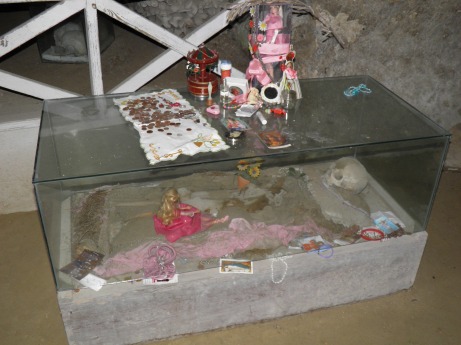
The requests were often quite tangible and intertwined with the social fabric of everyday life: finding a partner, getting married, winning the lottery, securing a job, having children, and so on. Once the grace was received, the soul became “Familiarized,” meaning it became a part of the family. Trinkets from trousseaus were donated, and sometimes even a small domestic area was constructed around the burial site.

The tiles are actual pieces from the adopters’ kitchen, crafted in the 1950s, aiming to recreate the quintessential family setting – the heart of every household: the kitchen.
Monday, a day consecrated to this ancestral practice, is a reminiscent tribute to the cults of Hecate, the Lady of the Night, entrusted with the “commerce” with the departed. Women would gather at the place of worship, armed with cotton, spirits, and mothballs, to start polishing the skulls. This act of cleansing would accelerate the ascent to paradise and thus facilitate intercession.
The ritual must strike a balance, not too swift or too protracted, to prevent the risk of “fixation” – binding the deceased too closely to the material world, hindering the soul’s intended passage.
Parallel to this personal devotion was the communal aspect. Women known as “maste,” possessing a unique sensitivity, would identify souls in need, while often, to intensify intercession, they would approach a “ministrante,” a virgin girl (in modern terms, one afflicted with epilepsy), who would fall into a trance and start foaming at the mouth. This foam signified grace and a forthcoming occurrence.
Children played a significant role, being considered more receptive due to their purity. Consequently, during prayers, they were often brought to these places of worship. Even the remains of deceased children held great potency; their skulls were highly sought after, bordering on scarcity. Devotees were encouraged to join a waiting list, serviced as new skulls arrived.
The custom of the “refrigerio,” or the deceased’s “thirst,” is an ancient motif. In the pagan world, the “refrigerium” was a funeral feast held at the tomb of the deceased. Often, bread was offered on tombs, symbolizing both nourishment and the rebirth of the departed in their new life. Even the Greeks and Romans commemorated their dead with votive offerings of food and wine on graves to appease the souls. Babylonians and Assyrians buried pots of honey. The use of actual food in tombs is evidenced by various texts, such as Michel Raufft’s “De Masticazione Mortuorum in Tumulis” and Philip Rohr’s “Dissertatio Historico-Philosophica de Masticatione Mortorum.” These texts describe how the deceased, lacking sufficient provisions, would start to feed by chewing on the burial shroud and their own flesh.
Abbot Calmet Agustin, referring to Raufft’s work, wrote, “It is a common opinion in Germany that certain dead people chew in their graves and devour everything around them… Raufft assumes that it is proven and certain that some deceased individuals have eaten their wrapped garments, and everything that was near them, and even devoured their own flesh.” He observed that in some parts of Germany, they placed a clump of earth beneath the shroud to prevent the dead from eating, while in other places, they put a small silver coin and a stone in their mouth, or tightly cinched their throat with a handkerchief.
St. Augustine, on the other hand, speaks about the “custom of Christians to bring meat and wine up to the graves, with which they make devotion meals.” He justifies, without endorsing, this pagan tradition, basing it on the Book of Tobit: “Place your bread and wine upon the tomb of the righteous, and do not eat and drink with sinners.”
Even the “pro anima” bread, typical of the Campania region, would serve a similar purpose. The food is often offered during nighttime vigils, at the entrance of the cemetery or the house of the mourners. Later, the term “refrigerio” became more associated with a form of refreshment for the souls. These souls, imagined to be enveloped in flames, needed water to cool down. This concept is already present in the Gospel,
…The rich man also died and was buried. And being in torments in Hades… he cried and said, ‘Father Abraham, have mercy on me, and send Lazarus to dip the tip of his finger in water and cool my tongue; for I am tormented in this flame…’.”
Thus, the custom of placing vases and glasses of fresh water near the deceased came into being. It was also common to leave a small opening or small holes on the tomb, from which to pour the precious liquid directly onto the deceased.
The most significant places of worship in the Campania region include the aforementioned Fontanelle Cemetery, the Church of Maria Santissima del Carmine, the Church of San Pietro ad Aram, built on the spot where tradition holds that Saint Peter baptized Saint Candida, and the Church of Santa Maria delle Anime del Purgatorio ad Arco on the central Via dei Tribunali.

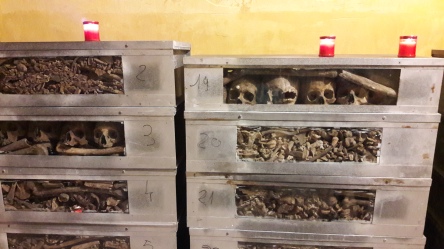

Despite being true cemeteries, these places take on the characteristics of a border zone, a chthonic “twilight” where the encounter between the living and the dead becomes possible.
“…Finally passing through the gate, I was struck by the spectacle that unfolded before my eyes. Nothing like the rows of mummies one sees at the Capuchin church in Palermo, nor akin to the elegant arabesques of bone fragments displayed at the Capuchins of the Immaculate Conception in Rome… Those heaps of bones, arranged on a sort of pavement along the galleries, aren’t very high, but within one gallery, amidst those bones, an arch of triumph is raised along the wall: the arch of the triumph of death. All around this funeral arch, flowers are scattered. Some bones are placed inside glass cases. Elsewhere, a candle is lit within a skull, thus it might portray the Holy Spirit above the heads of the Apostles. At times, the lit candle is placed inside the skull, giving it a diabolical appearance… The man who was praying, young with a voice akin to a preacher’s or a singer of Neapolitan songs, did not possess an ascetic demeanor; the joy of living was evident in his face. Add to this that he executed his task with conviction. A form of ritual was observed: the individual who desired a prayer recited would sit on a small bench next to the person reciting the prayer, as if consulting an oracle. Initially, the one who was praying remained still, then gradually, their head would begin to move, and their rosary beads would jingle like a bell… But rights do not come without duties. A woman who was losing her mind over not finding her own skull came seeking help from the “prayerful one.” ‘It’s a bright yellow skull,’ she said. And off they both went to search for it. ‘There it is,’ the “prayerful one” triumphantly shouted, uncovering the lost object. He waved it before the woman, blessed it gratuitously, and returned to his customers. One had to see the tenderness the woman had for that finally-retrieved skull! She blew dust off it, wiped it with her handkerchief, kissed it, cradled it, gently placed it on a small cushion she had brought along, and lit a bunch of candles around it. The choice of a skull is not taken lightly. Those who seek one walk slowly back and forth through the galleries, attentively scrutinizing those sorrowful remains of the dead. Suddenly, they stop and bend down to pick up a skull with no name on it; they examine it from all angles, test its consistency, turn it over and over, touch it, weigh it, and sniff it as one might sniff a melon. Immediately follows the cleaning. I’ve seen some young women perform it with all the skill of housewives: brushing, cleaning with alcohol, polishing with furniture wax. After two proper rubs, the skull would shine like a blazing new coin…”
This is the description provided by traveler Roger Peyrefitte in the 1940s of the Fontanelle Cemetery.

The Fontanelle Cemetery is, in fact, a tuff quarry dating back to the 1500s. It was originally used to extract construction material for the residences of its owner, Prince Carafa..

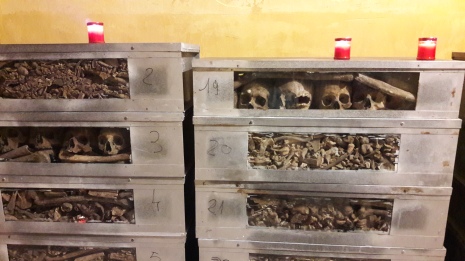
According to tradition, the name “Fontanelle” originates from small spring-like outlets that used to seep from the porous rock. Presently, the cemetery houses around 40,000 human remains. However, it is said that beneath the current walking level, there are compacted bones that extend at least four meters deep, meticulously arranged in the past by specialized gravediggers. All of these remains are rigorously anonymous, except for two: those of Count Filippo Carafa and Donna Margherita. The latter is still visible today in a glass case. Due to the skull’s wide-open mouth, a legend arose that she had died from choking on a gnocco (a type of Italian dumpling).
The cemetery as we know it was reorganized in the 19th century by Father Gaetano Barbati of the Mater Dei church, founder of the Opera Pia, and it was opened to the public in 1872.
Precisely because the bodies here are all anonymous, the cult of the “anima pezzentelle” (pauper souls) developed. It acts as a bridge between the afterlife and the earthly realm, a means of communication between the world of the deceased and the world of the living.
Upon entering the quarry, the devotee would make the sign of the cross. The place carried an absolute sacredness, permeated by a humidity that wasn’t natural but generated by the sweat of the souls in purgatory – an emanation from the beyond.

Among the numerous adopted skulls, the most famous is that of the “capitano” (captain). The most well-known version of the story is told by Roberto De Simone in his essay “Novelle K 666. Fra Mozart e Napoli.” “…A young Camorrista, a womanizer and a liar, dared to desecrate the Fontanelle Cemetery by making love there with a girl. Suddenly, he heard the voice of the captain reprimanding him. Mocking it, he responded that he wasn’t afraid of a dead man. When the captain’s curses grew stronger, the audacious young man challenged him to appear in person, sarcastically swearing to meet him on the day of his wedding (all the while secretly vowing never to marry). However, the young man, forgetting his oath, got married after some time. During the wedding banquet, a guest dressed in black, whom no one recognized and who stood out for his stern and silent demeanor, presented himself. At the end of the meal, when asked to reveal his identity, he said he had a gift for the newlyweds but wanted to show it to them privately. The newlyweds received him in the adjoining room, but when the young man recognized the captain, it took just a moment. The captain extended his fiery hands toward them, and from his scorching touch, the newlyweds fell dead instantly…”
The story, of course, is fictional. However, it references a popular tradition. In the past, particularly in the area of the cemetery known as “I Tribunali,” the initiation rituals of young Camorristi took place. The initiates, subjected to a test of courage, had to spend an entire night alone within the quarry.
Another significant place of worship was the Church of Santa Maria del Purgatorio, built in 1616, based on designs by Giovanni Cola di Franco and Giovan Giacomo Di Conforto. It was commissioned by various noble Neapolitan families with the aim of creating a burial site. The church has both an upper and lower section, developed with the idea of establishing a purgatorial cult and a cult for the living. The lower part was the true sancta sancturum, featuring an ossuary from which the faithful would retrieve the skulls.
Curiously, there was an old woman with a stall in the ossuary who sold flowers and candles. This business continued through the son, at least until the earthquake in 1980. The cult was widespread, with people coming to Naples from the surrounding provinces. On the Day of the Dead, the line of people extended all the way to Via Duomo. This was a cult that proved challenging for the Church to manage. This difficulty was the main reason for the subsequent ban.
The most powerful soul in the cemetery was Lucia. There are various versions of her story.
 .
.
t appears to be the story of Lucia D’Amore, the only daughter of Prince Domenico D’Amore of Ruffano. She was betrothed to Marquis Giacomo Santomago in 1789. However, Lucia was in love with a handsome young man from the lower classes. Refusing to marry the marquis, she chose to run away with her true love. Don Domenico caught up with them and killed them. Lucia becomes the victim of an unhappy marriage. Those who couldn’t get married or find a spouse would come to Lucia. Once their prayers were answered, they would bring her their engagement rings, which were then sewn onto her cushion. Even today, on Mondays, many women recite curious invocations that have lost their linguistic meaning, a form of “conjuring” magic.
Here is one of the most commonly used and understandable litanies:
“…Holy souls, purgating souls / I am alone and you are many / Go forward to my Lord / and recount all my sorrows / Before this holy day grows dark / I want to be consoled by God / Merciful God, redeemed by Your blood / to all the souls in Purgatory greet them at all times / Eternal Rest…”
In reality, according to the Church, only saints can grant and intercede with God, not the souls, especially those confined in Purgatory. In 1969, the Ecclesiastical Tribunal banned these religious manifestations.
“…the manifestations of worship that some faithful direct towards human bones variably arranged in certain churches of our archdiocese. Considering that those mortal remains cannot be identified as belonging to historically unknown individuals whose holiness of life in the heroic exercise of supernatural virtues can be proven (…), it declares that the manifestations of worship directed towards human remains variably buried in certain churches of our archdiocese are arbitrary, superstitious, and therefore inadmissible…”
Plates were placed on the altars to prevent contact with the faithful, but the rules remained unobserved. The faithful broke the protections, and the cult continued until the earthquake of 1980. The Archdiocese declared the Church of Purgatorio unsafe and closed it. This was the official reason for closing a highly uncomfortable cult. Only in 1992 was the church reopened as a monument, and the faithful had to and still have to adhere to the strict prohibitions of the cult.
We conclude our virtual tour with two crypts that have recently been opened by volunteers and are also visitable. The first is located beneath the Church of San Filippo e Giacomo.
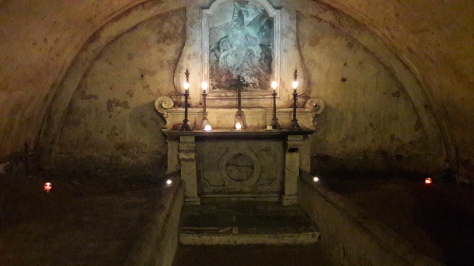
L’ultimo luogo di culto è la chiesa di S. Luciella ai Librai, which houses the well-known “Teschio con le Orecchie,” or a skull that has protrusions on the sides resembling earlobes. For the faithful, the ears represent a connection between the realm of the dead and the realm of the living. Many would go to the skull to entrust it with prayers, hopes, and fears, believing that, possessing the means to listen, it could more easily transmit the message to the appropriate entity on the other side. I hope I haven’t bored you during this curious journey. Naples will be the protagonist of our upcoming writings as well. Today, remember: Do good for the souls in Purgatory.
Naples and South America: Le Pezzentelle, Eguns, and Anima Sola
The famous Pulcinella mask, known worldwide as a symbol of the Campanian capital, is closely connected to the cult of deceased souls. The mask officially appeared in the 1500s through the actor Silvio Fiorillo and was brought into the spotlight as we know it today in the 1800s by Antonio Petito. The origins are lost in the mists of time. The name Pulcinella for some might derive from “little chick” or “chickling,” while for others, it might be a caricature of a peasant from Acerra named Puccio d’Aniello, who was a local clown in the 1600s. For yet others, its origins date back to the 4th century BC, with Pulcinella being a descendant of Maccus, a character from Roman theatrical performances, depicting a servant with a long nose and a chubby face. However, Pulcinella is much more. His white outfit and black mask are the typical colors of the world of the deceased, or rather the relationship between the world of the living and the world of the dead. In ancient times, white was the color of mourning attire, and even the reference to the chick, which has always been a symbol of the underworld in folk legends, is not coincidental. Pulcinella is thus a psychopomp, the ferryman of the afterlife, the one who communicates and bargains with Death, as many folk stories played out in puppet theaters attest. His liminal figure, interestingly, is also connected to South America. The colors of Pulcinella indeed bear a strong resemblance to the Petros Velhos, souls of the deceased who have completed their “cycle” and are considered spiritual guides in Candomblé and Umbanda. The playful and tricky nature of Pulcinella allows us to draw another comparison. Bruno Leone states, “…In the case of Pulcinella, in the ancient structure, there are many quite mysterious contacts with Africa. In this country, there are characters who have the same voice as Pulcinella, and they have the same symbolic meanings. For example, the relationship with the world of the dead, the mask as a means of dialogue with death: Pulcinella is a psychopomp, and the same thing is found in some African masks.” The aggressive, more docile and submissive, vital and playful Pulcinella seems to be directly connected to the revered Eshù, one of the most respected deities in Yoruba religion and related syncretic cults. Eshù serves as an intermediary between the gods (Orisha) and humans, embodying the vital energies that facilitate the passage of the Message. He is the lord of the Eguns, the spirits of the ancestors, in a ritual little known but that seems to be quite close to the one of the “pezzentelle” described thus far. In fact, the Eguns appear to be more closely tied to the concept of spiritualism and “entities” or “ghosts” rather than ancestors in the strict sense. There’s often talk of a secret society of Eguns’ worshippers, with clear influences from Kardecist spiritism, whose members adhere to extreme secrecy.
Please note that this passage seems to delve into a more speculative interpretation and connection between Pulcinella, African spiritualism, and local practices. If you have any specific questions or need further clarification, feel free to ask.
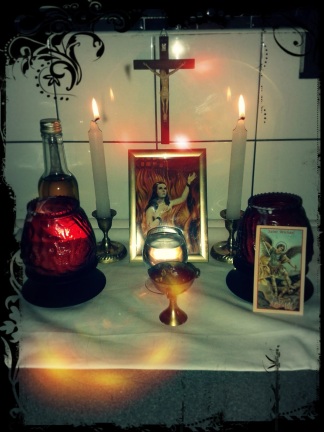
And Pulcinella reminds us of the cult of Eshu, the “pezzentelle” are closely connected to another widely practiced cult throughout the South American continent and particularly in Mexico, that of the “Anima Sola” (Lonely Soul). The most common iconography depicts a chained woman suffering amidst flames. Praying for the “Anima Sola” is a tradition that, in many aspects, differs from the more prevalent cult of saints. Instead of praying directly to a saint who then appeals to God, the “Anima Sola” represents the souls in purgatory, seeking assistance from the living and in return offering them something. In other words, it’s the abandoned soul that requests prayers and attention to expedite its ascent to paradise, thus becoming grateful to anyone who offers them.




 Centro Studio Misteri Italiani
Lascia un commento